Dye & Durham: Long Term Loan Due 2031
Long Term Loan Due 2031 at ~51 as of October 26, 2026
〰️
Long Term Loan Due 2031 at ~51 as of October 26, 2026 〰️
Situation Overview
Dye & Durham Corp. (TSX: DND) is the byproduct of an aggressive, debt-financed roll-up strategy, where the company managed to avoid integrating its acquired businesses until its heavy debt burden finally took a toll. The company has faced significant financial and operational stress in recent periods, driven by real estate market weakness, customer loss, volume and pricing pressures. Aside from earnings decay leading towards a liquidity crunch ahead of its 2028/2029 maturity wall, the company has contended with persistent leadership instability, cycling through multiple CEOs and CFOs, and required financial restatements.
While these dynamics made the name an extremely risky play in the past, the remaining current management team and board have been making a meaningful push towards operational improvement driven by automation and AI and cost discipline. Management is strictly focused on cash generation and deleveraging the balance sheet.
As a result, fiscal Q4’26 is demonstrating positive momentum with revenue and adjusted EBITDA up 4% YoY and 18% YoY, respectively, when excluding the divestiture of UK identity verification and anti-money-laundering compliance platform Credas. Cost saving initiatives have resulted in Q4’26 adjusted EBITDA margin of 53%, compared with 47% in Q3’26 and 45% in Q4’25, even though interim CEO and COO Todd Schulte noted that seasonality caused some of the sequential improvement.
The company has achieved approximately $20 million of annualized run-rate cost savings thus far, ahead of its fiscal 2026 target of $11 million, and expects to achieve its remaining initiatives of $6 million to $8 million in fiscal 2027.
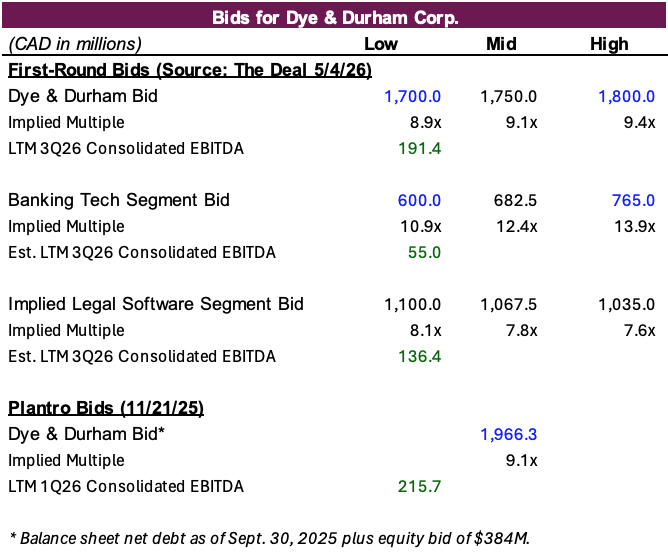
The company has retained Perella Weinberg as financial advisor and Goodmans as legal counsel as it aims to conclude its strategic review this fiscal year. Previous first-round bids for the entire business were valued at $1.7 billion to $1.8 billion and bids for the banking technology, or fintech, business were at $600 million to $765 million, according to The Deal as of May 4. However, the sale process slowed down amid poor fiscal Q3’26 results and the departure of former CEO George Tsivin.
In the meantime, a group of majority term lenders and secured noteholders, holding upwards of 60% of secured debt, signed a cooperation agreement, according to Octus on July 14. The group is working with Houlihan Lokey as financial advisor and Paul Hastings as counsel. Supposedly the group turned away creditors after its holdings hit a majority (we assume they reached 66.7%, but reports have not confirmed that), prompting the minority group of term lenders and secured noteholders to organize with Hogan Lovells Cadwalader as legal counsel, and retain Jefferies as financial advisor.
According to Octus reporting, the company has not engaged with any creditor groups and remains highly focused on its strategic review and operational initiatives. After reviewing the debt documents, we believe an aggressive LME is highly unlikely for this structure, not only due to limited covenant capacity to get a comprehensive deal done but also management’s demeanor thus far. If this structure happens to go down the restructuring route (which we don’t think will be the case, unless there is meaningful end-market volume deterioration and loss of all progress made on its cost initiatives), we suspect a consensual deal with all creditors is more likely than a non-pro-rata LME. Since in all non-pro-rata scenarios that we can imagine, the minority group would remain outstanding, making an LME pointless since the company would file for bankruptcy anyway. LME scenarios are discussed in detail further below.
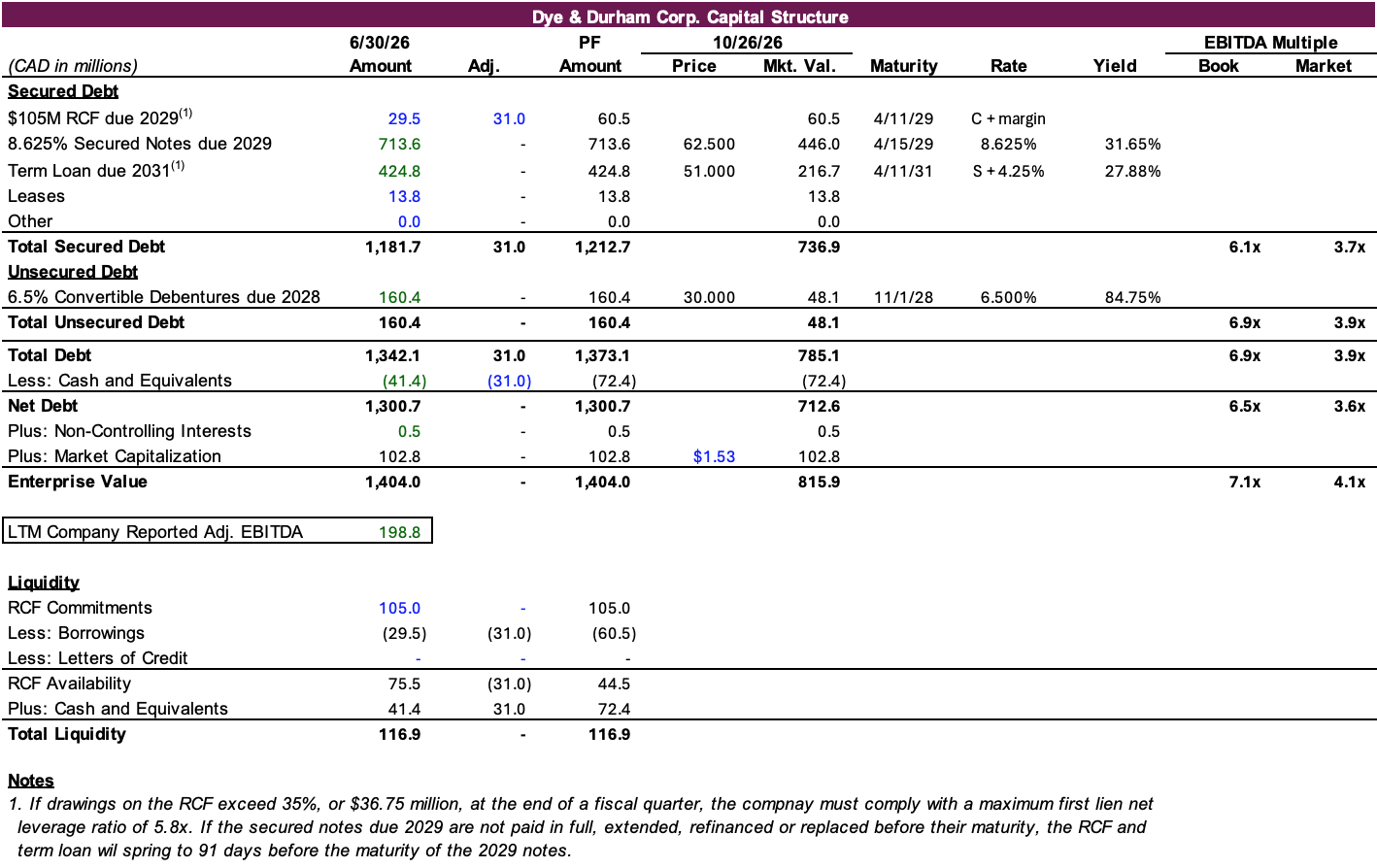
DND’s capital structure pro forma a $31 million revolver draw subsequent to the fiscal fourth-quarter end is shown below:
Investment Thesis
Dye & Durham’s term loan due 20231 currently trades at ~51 as of Oct. 26, according to Solve. When analyzing all possible capital structure scenarios through a game theory lens, the term loan due 2031 provides the highest risk-adjusted return within Dye & Durham’s capital structure.
In potential current and future restructuring scenarios, the term loan is within the fulcrum security class, resulting in post-reorganization equity, which offers significant upside to a housing market rebound. Plus, the term loan due 2031 is already trading at recovery prices, protecting against downside risk in any bankruptcy scenario.
IRRs for the secured notes and term loan in various game theory scenarios are compared below (current entry price for the term loan of 51 and the secured notes of 62.5).
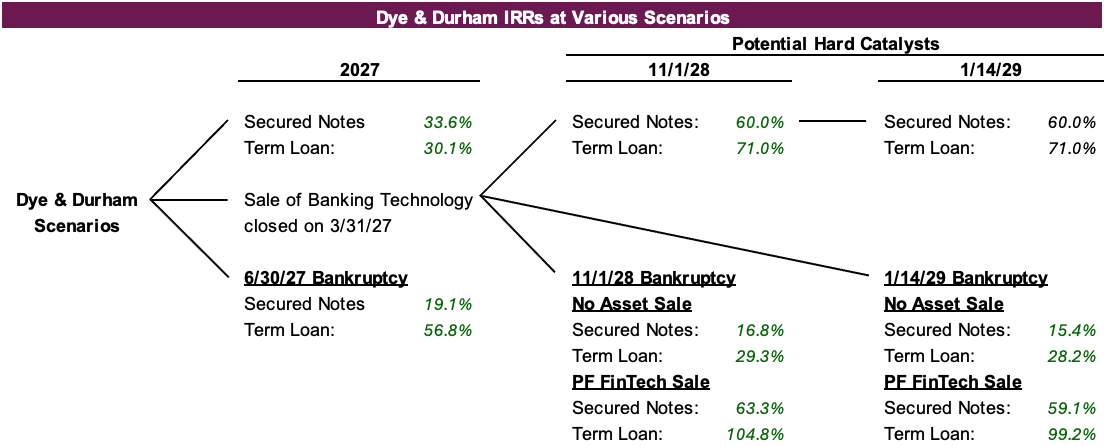
All but one scenario results in a lower IRR for the term loan, even then the difference is immaterial. Overall, the current trading price of the term loan, approximately 11.5 points below the secured notes, affords investors significantly higher returns than the notes.
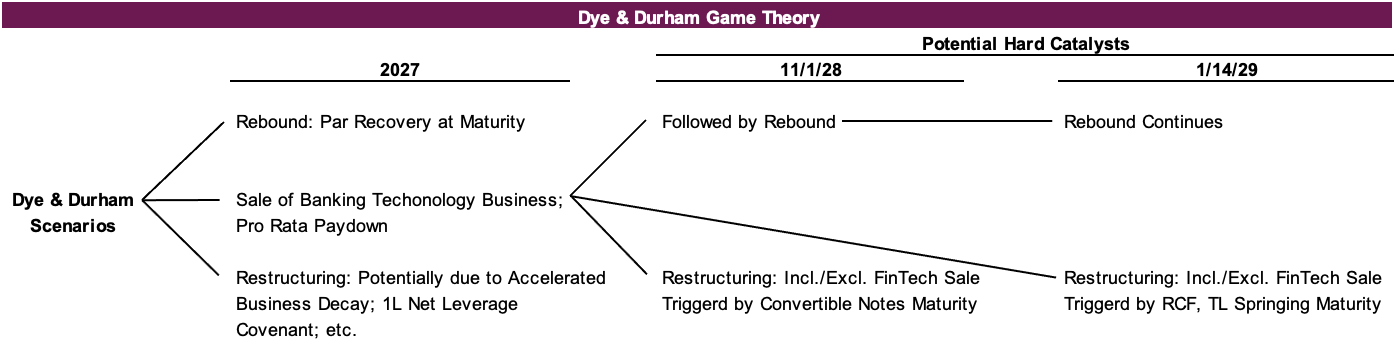
The three overarching game theory outcomes are a rebound in the business, the sale of its banking technology segment or a comprehensive restructuring (in or out of court, nonetheless, recoveries should be similar). We believe the most likely outcome will be a sale of the banking technology business with proceeds used to pay debt, followed by an eventual rebound in the remaining legal software business. The game theory matrix is discussed in detail below.
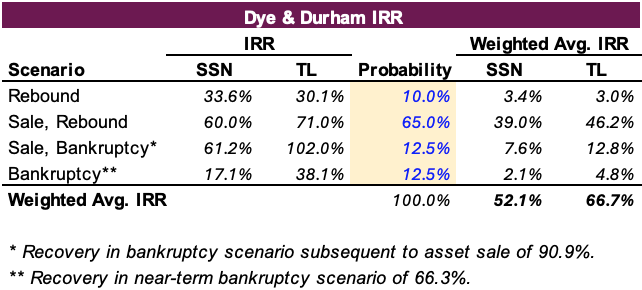
We calculate a weighted average IRR for the term loan of approximately 67% based on our estimated probabilities of various scenarios occurring:
Term Loan Offers Highest Returns in All Feasible Game Theory Scenarios
Dye & Durham can either:
1. Experience a rebound in its end-market volumes, while continuing to realize its cost initiatives, leading to a recovery in the business;
2. Conclude its strategic review, resulting in the sale of its banking technology business and paydown of a sizeable portion of its debt; or
3. Experience a meaningful deterioration in end-market volumes and lose all progress made on cost initiatives, resulting in a comprehensive in- or out-of-court restructuring (out-of-court options are likely restricted by limited covenant capacity, discussed further below).
A sale of the banking technology segment could result in proceeds to pay debt and additional liquidity and time to achieve its strategic and operational initiatives. Alternatively, selling its higher-margin and higher-multiple business could hurt DND if its cyclical legal software business doesn’t rebound in time, ultimately resulting in a restructuring at a later date. The company has been shopping the sale of its business as a whole, but we think it is highly unlikely that management will monetize at current severely discounted valuations.
A possible soft catalyst for a default and subsequent bankruptcy filing, if not cured, could be the 5.8x 1L net leverage covenant under the credit agreement tested when RCF commitment utilization exceeds 35%, or $36.75 million, at the end of any quarter. Similarly, cash burn and limited liquidity can serve as a catalyst for a restructuring at any time. Otherwise, hard catalysts include the maturity of the convertible debentures on Nov. 1, 2028, or the springing maturity of the RCF and term loan to Jan. 14, 2029, if the secured notes due 2029 remain outstanding 91 days prior to their maturity.
The possible outcomes for Dye & Durham are illustrated below:
Banking Technology Business Likely to be Sold to Reduce Debt
Candid Value believes that the company’s strategic review will result in the sale of the banking technology business. Previous bids for the segment were at $600 million to $765 million, according to The Deal on May 4, which at the time would imply an EV/EBITDA multiple range of 11x to 14x, based on our estimate for the segment’s EBITDA for the LTM period ended March 31 of $55 million, as shown below:
It is difficult to accurately decipher the profitability for each segment. However, EBITDA margins for the legal software business in 2026 of 45% to 50% imply banking technology margins of 58% to 44%. DND’s segment 2026 profitability sensitized based on legal software margins is illustrated below:
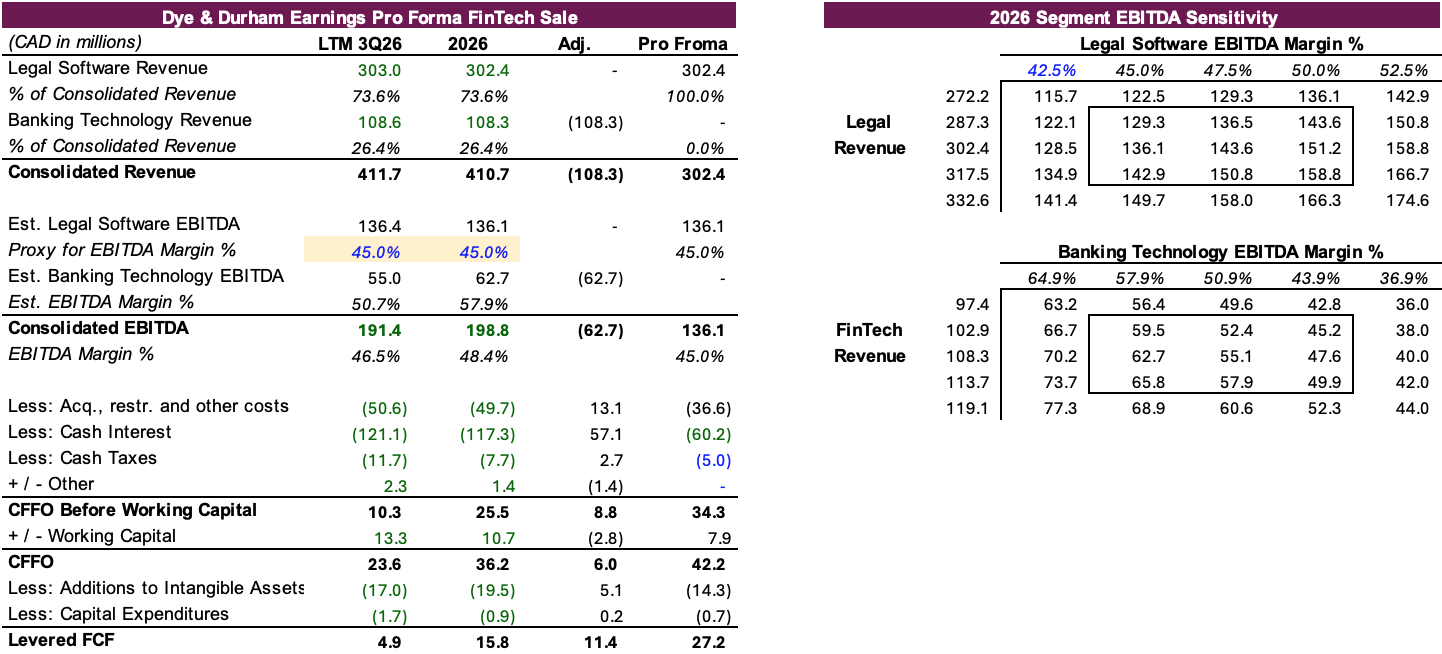
We estimate that the segment’s EBITDA improved to $62.7 million for the fiscal year 2026. We maintain that the segment can be sold for $600 million, resulting in the following pro forma capital structure:
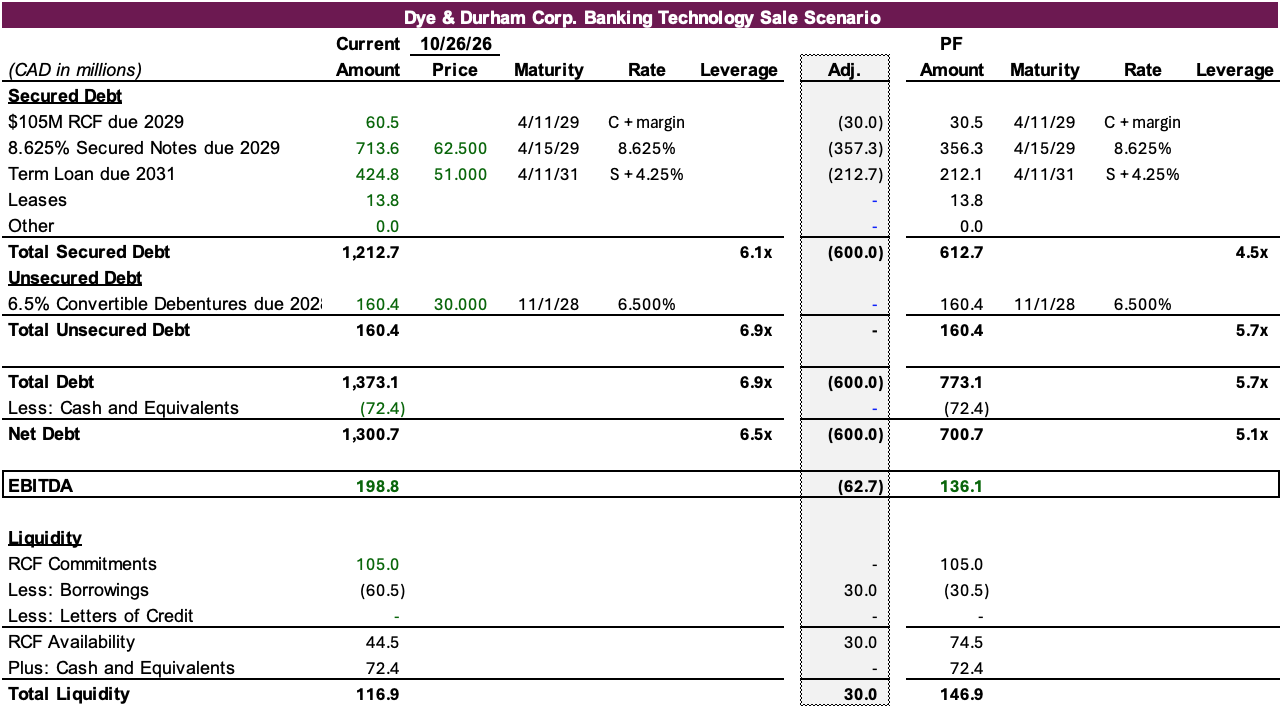
According to the debt documents, asset sale proceeds must first be applied to the RCF to bring its utilization of commitments to below 35%, or $36.75 million, capped at $30 million; then the remaining proceeds are shared pro rata among the term loan and secured notes. The secured notes indenture includes language regarding an “Excess Proceeds Offer,” however, that amount is contingent on the asset sale provisions under the credit agreement, which is a private document. Using the Credas’ asset sale as an example, proceeds were applied in a similar pro rata matter discussed above, so we use the same approach in the fintech sale scenario.
Term Loans Are Positioned for Upside in Restructuring Scenarios
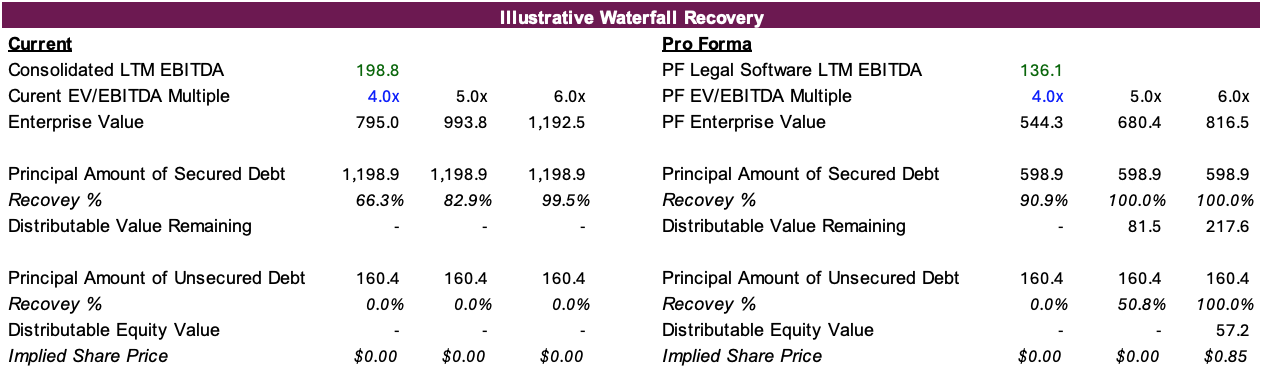
While Candid Value believes the remaining legal software business would continue to improve after the sale of the banking technology segment, an extended period of low end-market volumes could lead to a restructuring. In such a scenario, we suspect that secured lenders would recover ~90.9%, an improvement from current waterfall recoveries at ~66.3%. Although we use an extremely depressed multiple of 4x in both scenarios, which is unlikely to be used by advisors, recoveries are well above the current price for the term loan of 51. For illustrative purposes, we believe the low 4x to 6x multiples used below serve as proxy for worst case scenarios. In both instances the term loan remains within the fulcrum security class, affording it greater post-reorg equity upside from an eventual housing market transaction volume pickup.
DND’s waterfall recoveries in a current restructuring versus delayed restructuring after the sale of its fintech segment is shown below:
LME Risks Are Likely Overblown
Market chatter suggests that the majority group is eyeing the higher-margin and higher-multiple banking technology segment, hoping to get a structurally senior claim on the asset through an LME.
While the dispositions of equity, debt or assets of an unrestricted subsidiary are carved out of asset sale provisions under the secured notes indenture, transfers to unrestricted subsidiaries are capped at only $100 million (the greater of $100 million and 35% of EBITDA, or $69.6 million), which is not nearly enough to get anything meaningful done.
Furthermore, the December 2025 credit agreement amendment specifically confirmed that net sale or IPO proceeds from any subsidiary holding Financial Services Business assets must be swept to lenders under the asset sale mandatory prepayment provisions under the credit agreement. Since the credit agreement is private, we will assume the provisions require the proceeds to be shared in the manner discussed in the section above.
So contrary to market chatter, it seems like carving out the banking technology segment will be extremely difficult, if not impossible.
Other relevant provisions susceptible to amendments include:
· Subordination of all liens with 66.67% participation;
o However, all affected holders must be offered a bona fide opportunity to participate in the transaction (pro-rata-sharing provision only appears in lien subordination clause)
· Release of substantially all collateral with 66.67% consent (no pro-rata-sharing provision); and
· Release individual guarantors with majority consent.
The bona fide opportunity clause under the lien subordination covenant would defeat the purpose of any non-pro-rata maneuver since minority lenders must be offered to participate in the transaction as well.
There appears to be LME risk related to releasing all liens on assets with supermajority consent. We don’t envision DND going down an aggressive LME path where the majority group could offer the company an out-of-court solution while excluding minority lenders. There is no sponsor involved in the structure and a considerable amount of management has turned over as well, significantly limiting incentives to get an aggressive out-of-court restructuring done to revive its equity.
In all feasible non-pro-rata scenarios, the minority group would remain outstanding (albeit at a lien subordinated basis), making an LME pointless, unless majority lenders would have enough conviction in the business to redeem the minority group through some sort of a negotiated deal.
There have been rumors that if the company does go the bankruptcy track, it would prefer a CCAA process in Canada versus a chapter 11 in the US. CCAAs are generally more consensual among creditors and lower cost compared with a chapter 11 filing. We believe the lower cost and consensual theme underlying a CCAA directly contradicts the dynamics of an LME, where the company would incur significant advisor fees not only to effectuate the deal but sizeable litigation costs fighting against the minority group, ultimately defeating the purpose of an LME. We believe all potential outcomes suggest a consensual deal.
Dye & Durham Trades at Severely Depressed Multiples
Candid Value estimates Dye & Durham to be a 7x to 9x EV/EBITDA multiple business once its cyclical end market’s rebound and cost initiatives are achieved, equating to an enterprise value of $1.4 billion to $1.7 billion based on FY26 EBITDA of $198.8 million.
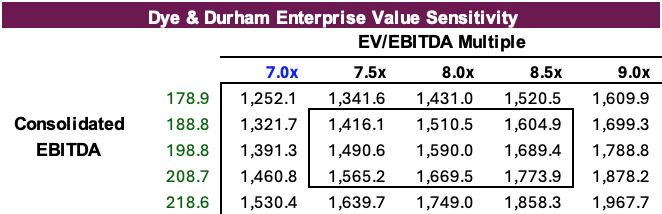
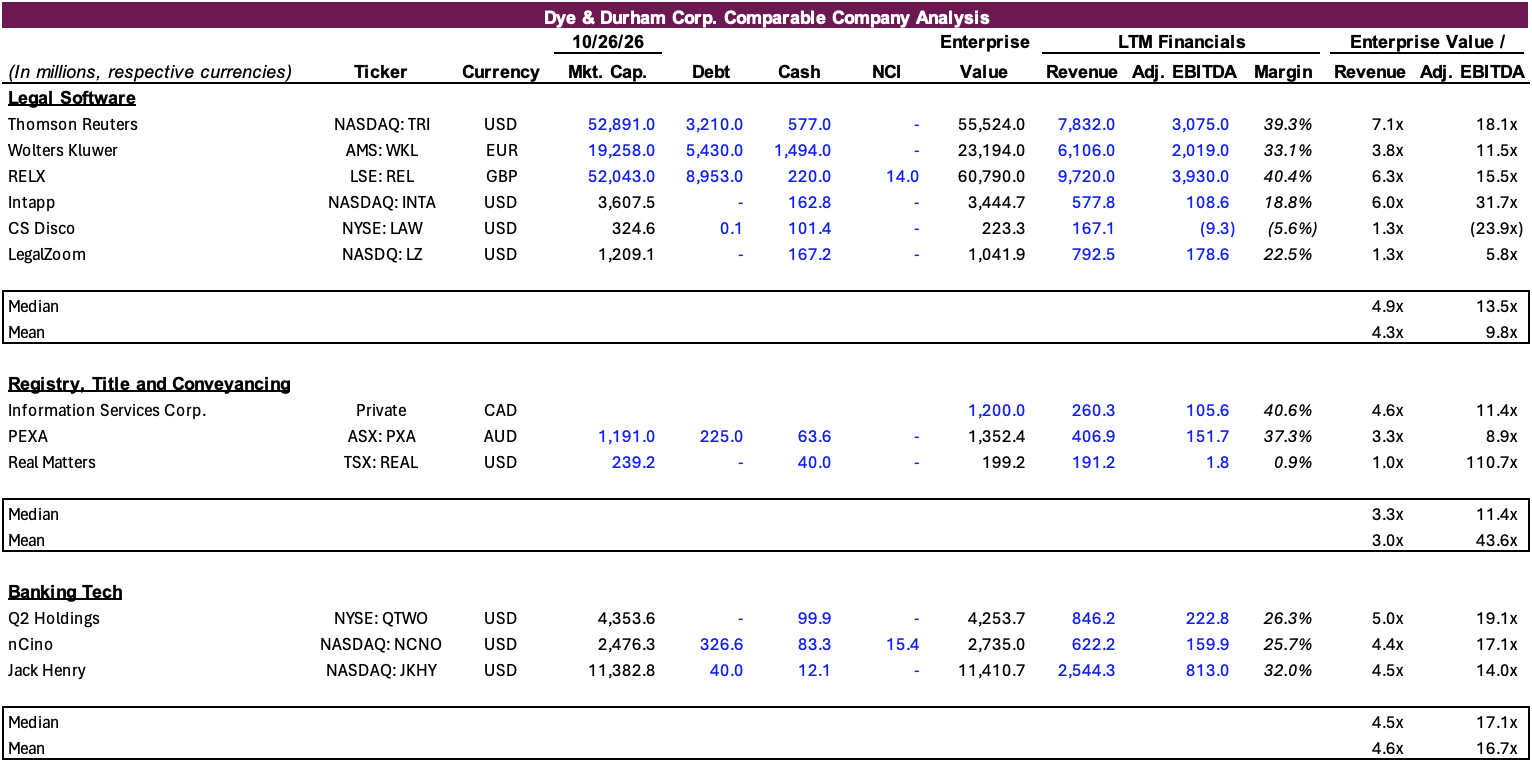
This multiple range is still far below comparable public companies. In our opinion, the best comparable company appears to be PEXA, an Australian registry, title and conveyancing business, which trades at 8.9x.
Due to DND’s different segments, none of the companies shown below are a direct comp, however, the legal software segment may be comparable to the legal software and registry, title and conveyancing companies below. While the business technology segment is directionally comparable to the banking tech companies below:
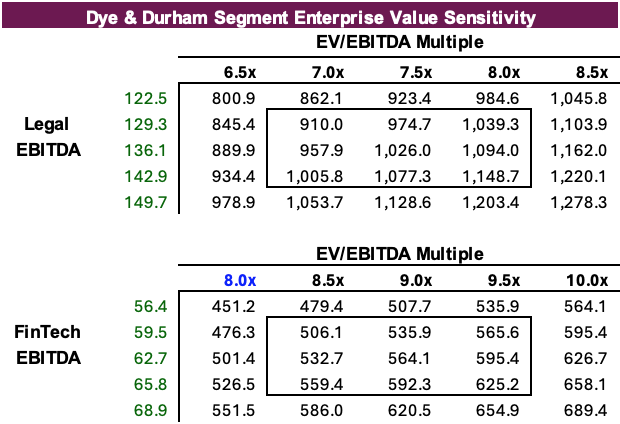
Enterprise value estimates for DND’s segments are shown below:
Q4’26 Positive Momentum Should Continue into Fiscal 2027
Candid Value’s financial forecasts are driven by estimated volume and price metrics, based on customer count of 35,800 provided in the company’s fiscal Q3’25 earnings presentation. We used segment results and management commentary to roughly trend customer counts at fiscal year end 2026 of approximately 16,700 in Canada, 6,200 in UK & Ireland (accounting for the customer loss from the Credas divestiture), 9,310 in Australia and 480 in South Africa. Overall management commentary during the Q4’26 earnings call notes that customer churn has started to stabilize and the company expects to hold prices steady going forward.
With respect to our forecast, we keep QoQ customer volumes flat across all regions until fiscal H2’27 where Canada grows 25 bps QoQ in Q3’27 and 50 bps QoQ in Q4’27, and UK & Ireland grows 25 bps QoQ in both Q3’27 and Q4’27. The fiscal H2’27 pickup in Canda is followed by 1% YoY and 2% YoY customer volume improvements in fiscal 2028 and 2029, respectively. Our Canadian forecasts are based on the Royal Bank of Canada’s CFO Katherine Gibson commentary expecting the Canadian housing market to turn around in 2027. Regarding the UK, the management of Mortgage Advice Bureau does not expect a short-term recovery in UK housing purchase activity but notes a large refinancing opportunity in 2027 with fixed-rate maturities around 30% higher YoY. Yet, we remain relatively conservative in our volume growth assumptions, severing closer to a bear case.
We maintain implied prices flat for each region on a YoY basis, owing to the seasonality in the business.
The company made meaningful headway in its cost initiative, noting that it achieved approximately $20 million of annualized run-rate cost savings in fiscal 2026, which was ahead of the fiscal 2026 target of $11 million. The company expects to achieve its remaining initiatives of $6 million to $8 million in fiscal 2027.
As a result, we keep segment direct costs as a percentage of revenue constant with the margin achieved in fiscal 2026 for all periods going forward. We fluctuate operating expense line items by segment to ultimately reflect annualized run-rate cost savings of $23.9 million by fiscal year end 2027. Summary financials are shown on the next page, but please refer to the accompanying Excel model for an in-depth breakdown.